Have Something in Your Back Pocket: Meaning, Examples & How to Use It
September 5, 2026
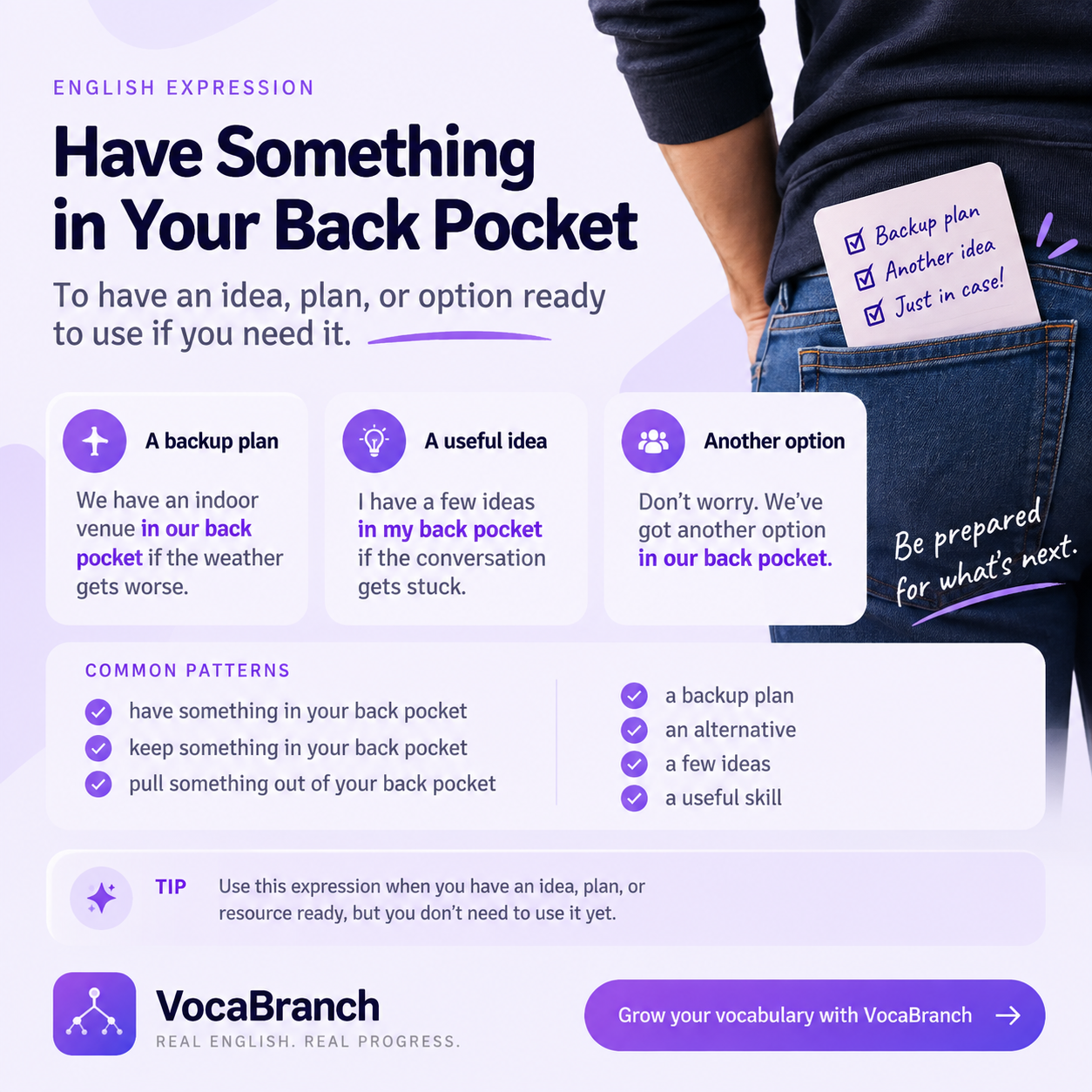
Have Something in Your Back Pocket
Pronunciation
US: /hæv ˈsʌmθɪŋ ɪn jʊr bæk ˈpɑːkɪt/
UK: /hæv ˈsʌmθɪŋ ɪn jɔː bæk ˈpɒkɪt/
Part of Speech: Idiomatic expression
CEFR Level: B2
What Does "Have Something in Your Back Pocket" Mean?
Have something in your back pocket means to have an idea, plan, resource, or option ready to use if you need it.
The expression suggests that you have something prepared but don't need to use it yet.
For example:
We don't need to change the plan yet, but we should have a backup option in our back pocket.
You have another option ready in case the first plan doesn't work.
When Do Native Speakers Use It?
Native speakers use have something in your back pocket when talking about being prepared for an unexpected situation or having an extra option available.
It can be used for:
- plans
- ideas
- solutions
- strategies
- arguments
- skills
- resources
- alternatives
It's especially common when someone wants to communicate:
"I have another option ready if this one doesn't work."
Example Situations
A backup plan
You're organizing an outdoor event, but the weather might be bad.
We have an outdoor venue booked, but we should have an indoor option in our back pocket.
You don't necessarily need the indoor venue. It's simply a backup.
A useful idea
You're having a difficult conversation and aren't sure how it will go.
I have a few ideas in my back pocket in case the conversation gets stuck.
You have some ideas ready that you can use if necessary.
A useful skill
Someone has several skills that could help them in different situations.
She's a great teacher, but she also has graphic design skills in her back pocket.
The skill is available to her if she needs it.
Example Sentences
I have a few ideas in my back pocket if the first approach doesn't work.
We should have a backup plan in our back pocket.
Don't worry. I've got something in my back pocket.
She always has a clever solution in her back pocket.
I have a couple of alternatives in my back pocket just in case.
He came to the interview with several questions in his back pocket.
If the weather gets worse, we've got another option in our back pocket.
She had one more argument in her back pocket when the discussion took an unexpected turn.
Common Patterns
You'll often hear the expression in these forms:
Have something in your back pocket
I have a few ideas in my back pocket.
Have something up your sleeve
This is a very similar expression.
She always has something up her sleeve.
Keep something in your back pocket
This emphasizes keeping something available for later.
Let's keep that idea in our back pocket for now.
Pull something out of your back pocket
This means to suddenly use a prepared idea, solution, or resource.
When the original plan failed, she pulled another solution out of her back pocket.
Common Collocations
These are some of the most natural things to have in your back pocket:
- a backup plan
- an alternative
- another option
- an idea
- a solution
- a strategy
- a few questions
- an argument
- a resource
- a few tricks
Examples:
Always have a backup plan in your back pocket.
I have a few questions in my back pocket if the conversation slows down.
We should keep another option in our back pocket.
Synonyms and Similar Expressions
Have a backup plan
The most direct alternative.
We have a backup plan if the event gets canceled.
Have something ready
A simple, neutral expression.
I have another idea ready if this doesn't work.
Keep an option open
Means not eliminating a possible choice.
Let's keep that option open for now.
Have something up your sleeve
A very similar idiom meaning to have a secret or unexpected idea, plan, or advantage available.
She always has something up her sleeve.
What's the Difference Between "In My Back Pocket" and "Up My Sleeve"?
These expressions are similar, but there's a small difference.
In my back pocket usually emphasizes having something available as a backup or useful option.
I have another plan in my back pocket.
Up my sleeve often suggests something unexpected, surprising, or clever.
Don't worry. I have a trick up my sleeve.
They can sometimes be used interchangeably.
Common Learner Mistakes
❌ Take something from your back pocket literally
In this expression, back pocket is usually metaphorical.
You don't necessarily have anything physically in your pocket.
I have a solution in my back pocket.
This means you have a solution ready—not that you're literally carrying it in your pocket.
❌ Use it only for emergency situations
Something in your back pocket doesn't have to be an emergency backup.
It can simply be a useful option that you haven't used yet.
I have a few conversation topics in my back pocket.
❌ "Have in the back pocket"
When referring to your own option, the natural expression is:
✅ I have an idea in my back pocket.
You can also say:
✅ I have a few ideas in my back pocket.
Usage Notes
Register: Informal to Neutral
Have something in your back pocket is common in spoken English and informal writing.
You'll often hear it when people talk about preparation, negotiations, presentations, problem-solving, interviews, and unexpected situations.
It usually has a positive meaning: being prepared without immediately using everything you have available.
Related Vocabulary
If you found this expression useful, you might also enjoy learning:
- backup plan
- alternative
- option
- have something up your sleeve
- keep your options open
- just in case
- plan B
- contingency plan
Quick Recap
Have something in your back pocket means to have an idea, plan, solution, or option ready to use if you need it.
A common pattern is:
I have something in my back pocket.
You can also use:
Keep something in your back pocket.
This means to keep an idea or option available for later.
Practice
Which sentence uses the expression correctly?
A. We don't need to use that idea now, but let's keep it in our back pocket.
B. I put my idea in my back pocket because my jeans were full.
Answer: A. Here, keep it in our back pocket means to keep an idea available in case it becomes useful later.
Practice This Expression with Vocabranch
Want to actually use this expression naturally? Add it to your Vocabranch vocabulary and practice it with personalized review sessions, realistic examples, and AI-powered speaking and writing feedback until it becomes part of your everyday English.