On the Fence: Meaning, Examples & How to Use It
September 6, 2026
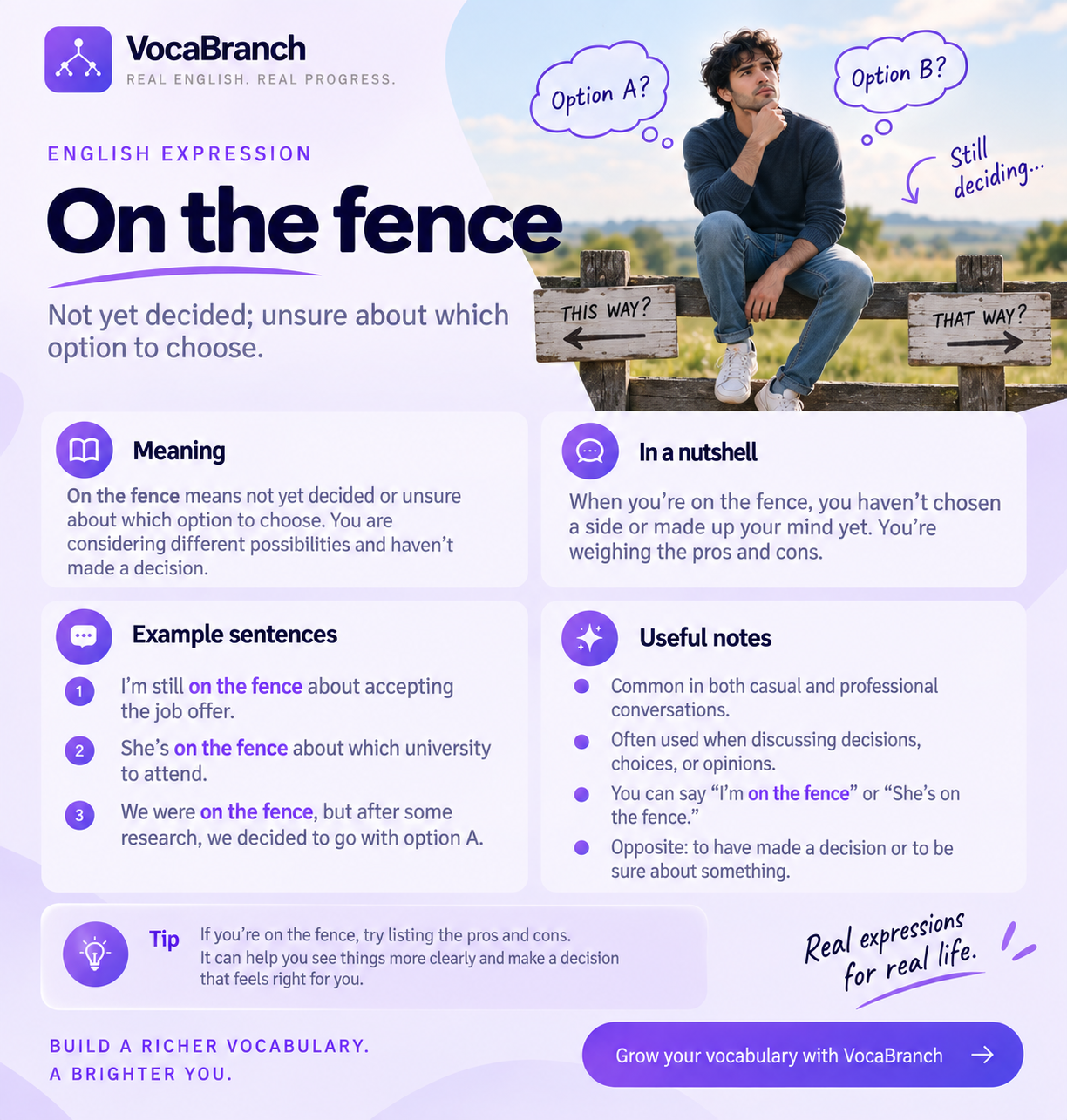
Meaning
On the fence means that you haven't made a decision yet. You're unsure which option to choose or which side to support.
When you're on the fence, you're considering different possibilities and weighing the pros and cons.
I'm still on the fence about accepting the job offer.
This means the person hasn't decided whether to accept the job.
The expression can also describe someone who hasn't decided what they think about an issue:
I'm still on the fence about the new policy.
When Native Speakers Use It
Native speakers commonly use on the fence when talking about:
- Making decisions
- Choosing between options
- Accepting or rejecting something
- Opinions or preferences
- Plans and future choices
It's natural in both casual and professional conversations.
At work
I'm on the fence about whether we should launch the project now.
In everyday conversation
I'm on the fence about buying a new car.
When discussing plans
We're still on the fence about where to go for vacation.
Example Sentences
- I'm still on the fence about accepting the job offer.
- She's on the fence about which university to attend.
- We're on the fence about going to the party tonight.
- He's been on the fence about moving to another city.
- I'm still on the fence about whether I should apply.
- They were on the fence about the decision for several weeks.
- After talking to my family, I'm still on the fence.
Common Patterns
Be on the fence about + noun
I'm on the fence about the new proposal.
Be on the fence about + -ing
She's on the fence about changing jobs.
Be on the fence about whether...
I'm on the fence about whether I should take the offer.
You can also simply say:
I'm still on the fence.
The context usually makes it clear what decision you're talking about.
Get Off the Fence
A closely related expression is get off the fence.
It means to finally make a decision after being undecided.
You've been thinking about it for weeks. It's time to get off the fence.
You might also hear:
We need to get off the fence and make a decision.
Another variation is sit on the fence, which means to remain undecided.
He's been sitting on the fence for months.
Synonyms
Depending on the context, you could use:
- be undecided
- be unsure
- be torn
- be hesitant
- can't make up my mind
- be in two minds
For example:
I'm torn between the two options.
This is similar to:
I'm on the fence between the two options.
Opposite Ideas
The opposite of being on the fence is being certain or having made a decision.
You could say:
- make up your mind
- make a decision
- be certain
- be sure
- know where you stand
- decide
For example:
I've made up my mind. I'm going to accept the offer.
Common Collocations
Some natural combinations include:
- be on the fence
- still on the fence
- remain on the fence
- get off the fence
- sit on the fence
- on the fence about a decision
- on the fence about something
- on the fence about doing something
Examples
I'm still on the fence about it.
She's been on the fence about changing jobs.
We need to get off the fence and decide.
Common Learner Mistakes
❌ "I'm in the fence about it."
✅ "I'm on the fence about it."
The expression uses on, not in.
❌ "I'm on the fence to buy it."
✅ "I'm on the fence about buying it."
When you're talking about something you're considering doing, about + -ing is a natural pattern.
Usage Notes
On the fence is an informal but very common English expression.
It's useful when you want to communicate uncertainty about a decision without simply saying:
I don't know.
Compare:
I don't know if I want the job.
with:
I'm on the fence about the job.
The second emphasizes that you've considered the decision but haven't made up your mind yet.
The expression can refer to relatively small decisions:
I'm on the fence about which restaurant to try.
Or much bigger decisions:
They're on the fence about moving to another country.
Related Vocabulary
- undecided — not having made a decision
- hesitant — unsure about whether to do something
- torn — having difficulty choosing between two possibilities
- pros and cons — the advantages and disadvantages of something
- make up your mind — decide what you want to do
- the big decision — an important choice
Quick Recap
On the fence means undecided or unsure about a choice.
Think of someone sitting on a fence between two sides, not ready to choose either one.
I'm on the fence about moving.
Once you finally decide, you can get off the fence.
Build Your Vocabulary with VocaBranch
Want to actually use this expression naturally?
Add it to your VocaBranch vocabulary and practice it with personalized review sessions, realistic examples, and AI-powered speaking and writing feedback until it becomes part of your everyday English.
Real English. Real progress.