Whack-a-Mole: Meaning, Examples, Synonyms & How to Use It
July 6, 2026
Pronunciation
US: /ˌwæk ə ˈmoʊl/
UK: /ˌwæk ə ˈməʊl/
Part of Speech: Noun (idiomatic expression)
CEFR Level: C1
What Does "Whack-a-Mole" Mean?
Whack-a-mole describes a situation where solving one problem causes another similar problem to appear somewhere else, making it feel like you're making little or no overall progress.
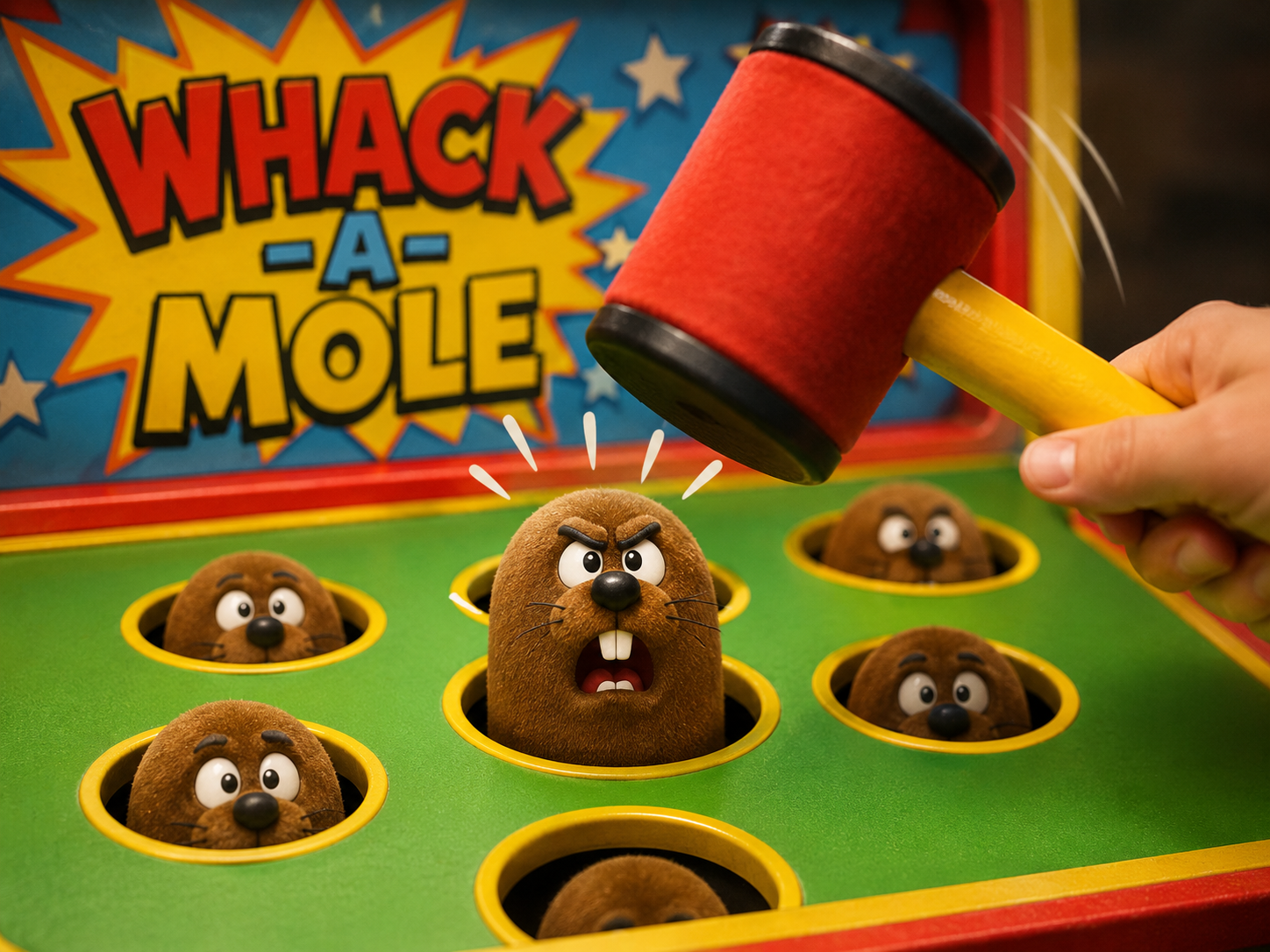
The expression comes from the popular arcade game Whac-A-Mole, where plastic moles randomly pop out of holes. Every time you hit one with a mallet, another appears somewhere else.
Today, English speakers use whack-a-mole as a metaphor for recurring problems that never seem to end.
When Do Native Speakers Use It?
Native speakers use whack-a-mole when they want to describe a frustrating situation in which problems keep appearing one after another.
Instead of making lasting progress, they feel like they're constantly reacting to the next issue.
The expression can describe almost any recurring challenge—at work, at home, at school, or in everyday life.
Example Situations
Imagine these scenarios:
- Every time you clean one part of your house, another room becomes messy.
- You remove weeds from one area of your garden, only to find new ones growing somewhere else.
- A company solves one customer complaint, but a different complaint quickly takes its place.
- A teacher helps one student resolve a problem, and another student immediately needs assistance.
- You finish one item on your to-do list, but two more urgent tasks suddenly appear.
- A city repairs one pothole, only for another to appear on a nearby street.
In each case, solving one problem doesn't end the cycle—it simply reveals the next one. That's exactly what whack-a-mole means.
Example Sentences
Here are some natural examples:
Fixing production bugs has become a game of whack-a-mole. Every bug we solve reveals another one.
Every time I organize one closet, another part of the house becomes cluttered. It's like playing whack-a-mole.
We keep patching the problem, but it's just whack-a-mole until we address the root cause.
Managing my inbox feels like whack-a-mole—I answer one email, and three more arrive.
Every time we solve one customer complaint, another issue pops up. It's a constant game of whack-a-mole.
Looking after an old house sometimes feels like whack-a-mole. One repair leads to another.
Instead of treating symptoms, let's solve the root cause and stop playing whack-a-mole.
Trying to keep spam out of my inbox is a never-ending game of whack-a-mole.
Synonyms and Similar Expressions
While none mean exactly the same thing, these expressions convey a similar idea.
Put out fires
Handling urgent problems as they happen instead of preventing them.
Our team spends all day putting out fires.
Fight an uphill battle
Working very hard with little visible progress.
Finding an affordable apartment felt like an uphill battle.
Chase your tail
Working hard without making meaningful progress.
We've been chasing our tails all week trying to get everything done.
Treat the symptoms, not the disease
Fixing surface-level problems without addressing the underlying cause.
We're treating the symptoms instead of solving the real issue.
Opposite Ideas
These expressions emphasize solving problems permanently rather than reacting to them.
- Solve the root cause.
- Fix it once and for all.
- Take a proactive approach.
- Build a long-term solution.
- Get ahead of the problem.
Common Collocations
You'll often hear whack-a-mole used with these phrases:
- play whack-a-mole
- a game of whack-a-mole
- never-ending whack-a-mole
- whack-a-mole approach
- whack-a-mole problem
- whack-a-mole strategy
Examples:
We're playing whack-a-mole with customer complaints.
It feels like a never-ending game of whack-a-mole.
We need a better solution instead of this whack-a-mole approach.
Common Learner Mistakes
❌ Play the whack-a-mole
Native speakers usually say:
✅ play whack-a-mole
❌ Use it for any difficult problem
Not every difficult problem is whack-a-mole.
The expression specifically describes problems that keep reappearing, often in different forms.
❌ Confuse it with multitasking
Whack-a-mole isn't about doing many things at once.
It's about repeatedly dealing with recurring problems instead of solving the underlying issue.
Usage Notes
Register: Informal to Neutral
This expression is common in both professional and everyday conversations.
You'll hear it when people talk about recurring challenges in areas such as work, home life, education, customer service, technology, or public services.
Related Vocabulary
If you found this expression useful, you might also enjoy learning:
- root cause
- put out fires
- quick fix
- workaround
- bandaid solution
- recurring problem
- proactive
- reactive
- bottleneck
Quick Recap
Whack-a-mole describes a situation where solving one problem simply causes another similar problem to appear, creating a frustrating cycle of constant reaction instead of lasting progress.
Whenever you feel like you're solving the same kind of problem over and over again, whack-a-mole is the perfect expression.
Practice
Which situation best describes "whack-a-mole"?
A. A city redesigns an intersection, permanently eliminating traffic congestion.
B. Every week, a homeowner fixes one plumbing problem only to discover another leak somewhere else.
Answer: B. Solving one problem simply leads to another, creating a cycle of recurring issues.
Practice This Expression with Vocabranch
Want to actually use this expression naturally? Add it to your Vocabranch vocabulary and practice it with personalized review sessions, realistic examples, and AI-powered speaking and writing feedback until it becomes part of your everyday English.